1.Forwards
Manuscripts should be prepared in accordance with "Publishing Policy”", "Instructions to Authors" and this "Submission Guidelines". If a manuscript does not follow The Journal's style and format, The Editorial Board may request amendment before commencing the review process. If you have any questions when preparing your manuscript, please feel free to contact to The Editorial Office (jjb@mail.tsumura.co.jp).
Submissions are only received via the online submission system, Editorial Manager® (https://www.editorialmanager.com/jjb), but if you encounter any difficulties using the system, please contact The Editorial Office.
When preparing a manuscript in Japanese, authors should refer to the Japanese Guidelines.
2.File Format for Submission Data
Authors must prepare submission data in the following file format. The cover page is not required, as it is automatically generated by the submission system based on the input information.
- ・Main text (Manuscript): Microsoft Word (.docx).
Authors must submit the revised manuscript as a finalized (clean) version. A file with tracked changes or comments must not be used as a manuscript. If authors wish to provide such a version to clarify the revised parts for the referee(s), it should be submitted as part of the "Response to Referee."
- ・Figure: JPEG, TIFF, EPS, PDF or Microsoft PowerPoint (.pptx)
- ・Table: Microsoft Word or Microsoft Excel (.xlsx)
- ・Appendix: Microsoft Word or Microsoft Excel (.xlsx), JPEG, TIFF, EPS, PDF or Microsoft PowerPoint (.pptx).
- ・Response to Referee: Microsoft Word (.docx)
- ・Supplementary data: For the file format, refer to J-STAGE's "File formats for supplementary data" (https://www.jstage.jst.go.jp/static/files/ja/UM-01-004_sousa(henshu)_append5.pdf).
- ・Others: File format is not restricted.
- -Authors may register materials such as original (unprocessed) data files, and additional documentation relevant to the submission as files under the file type "Others."
- -Files submitted as "Others" are not considered part of the formal review materials. However, they may be provided to the referee(s) at the discretion of The Editorial Board.
3.Style of Manuscript
3.1.Page Layout
- ・Page size: A4 (210 × 297 mm).
- ・Margin: 30 mm margins all around.
- ・Column setting: Single-column format.
- ・Line number: No line numbers.
- ・Characters per line and lines per page: Use standard character count.
- ・Line spacing: Double.
- ・Spacing before and after paragraph: 0 pt.
If authors need space between paragraphs, they should insert a blank line.
3.2.Font
Use of fonts other than the following specified fonts is not permitted. If authors choose to use non-specified fonts, they must do so at their own risk, acknowledging the possibility of character corruption.
- ・Font: Times New Roman, MS Mincho
- ・Font size: 12 pt.
3.3.Others
- ・Indentation setting: Body text should be indented 12.7 mm. References and figure captions should have a 12.7 mm hanging indent.
- ・Section breaks: Prohibited. Section breaks disrupt the editing process and must not be used by authors.
- ・Word style settings and other design elements: Prohibited. These elements interfere with editing and must not be used by authors.
Example of prohibited elements include:- -Use of Word's built-in title or heading styles
- -Bullet points or numbered lists created using Word's list functions
- -Inserting horizontal lines or borders
- -Shading (e.g., applying background color to text or paragraphs)
4.Manuscript arrangement
4.1.Original and Review
- ・Arrangement order: Title, Authors, Affiliations and their addresses, Summary, Key words, Introduction, Materials and Methods, Results, Discussions, Acknowledgements, References, Appendix, Figure Explanations.
- ・"Introduction" and "Acknowledgements" do not require headings; simply separate them form the main text with a blank line.
4.2.Note and News
- ・Arrangement order: Same order as Originals and Reviews, but Key words are not required.
4.3.Book Review
- ・Arrangement order: Title, body text.
- ・In the title section of Book reviews, the following information should be included: The book's Author(s), Title, Dimensions, Total number of pages, Publisher, Price, and ISBN.
- ・The reviewer’s name and affiliation should be provided at the end of the manuscript. The reviewer’s contact information (email address) should not be included in the manuscript, but should be provided separately for editorial correspondence.
5.Title
- ・Title should concisely and clearly represent the content of the manuscript.
- ・Authors of scientific names are not included in the title. However, this does not apply when the author names of scientific names are the subject of the manuscript.
- ・Do not use "nov." in the title. Instead, authors may use expression such as "new species" or other appropriate alternatives.
7.Affiliations and Addresses
- ・Affiliations should be listed in the following order: the name of the organization followed by its location.
- ・When a personal home address is used for affiliation, only the city, ward, town, or village should be provided.
- ・When multiple affiliations are listed, each affiliation should be distinguished by superscript Arabic numerals (1, 2, 3, ...). Each affiliation should be presented on a separate line and terminated with a semicolon (;) except for the final affiliation.
- ・The affiliations corresponding to each author should be indicated by superscript numerals placed next to the author's name.
- ・If an author's affiliation has changed and both the current affiliation and the former affiliation are listed, the current affiliation must be assigned a separate affiliation numeral. Following the affiliation numeral, "Present address:" should be given, followed by the affiliation name and address.
8.Address for correspondence
- ・The contact address for the manuscript is designated to only one author. Multiple authors cannot be designated.
- ・The contact address should be listed next to the affiliations as "Address for correspondence:" followed by the name and email address.
Authors may register only one email address.
- ・If there is only one author, the contact address should be listed next to the affiliation as "E-mail:" followed by the author's email address.
9.Summary
9.1.Original, Review and Note
- ・Regardless of whether the manuscript is written in Japanese or English, both an English and Japanese abstract are required: up to 200 words in English and up to 400 characters in Japanese is required. Longer summary need consent of Editorial Committee.
For foreign authors only, if preparing the Japanese abstract is difficult, the Editorial Board will prepare the Japanese title and abstract.
- ・The abstract should be written in one paragraph without separating into multiple paragraphs.
- ・Continuing articles should cite their previous publication at the end of the abstract, formatted as '(Continued from journal, volume, page numbers, year.). For the abbreviations of the Journal name, refer to '13.2.1. Citing Journals'.
9.2.News
- ・In the case that the article is written in Japanese, an English abstract (up to 200 words) is required.
- ・In the case that the article is written in English, a Japanese abstract (up to 400 characters) is required.
- ・Longer summary need consent of Editorial Committee.
- ・If authors have any difficulty preparing the abstract, the Editorial Board will prepare the abstract on behalf of the authors.
9.3.Others
Other types of manuscripts do not require an abstract. If the Editorial Board considers that an abstract is necessary, they will request the authors to prepare it, or the Editorial Board will prepare the abstract on behalf of the authors.
10.Key words
For Original Articles and Reviews, ten or fewer keywords (or short phrases, such as 'adaptive radiation') should be written in alphabetical order. Other types of articles do not require keywords.
11.Acknowledgements
Grants-in-Aid should be noted in the acknowledgements.
12.Footnotes
Footnotes are not accepted. If additional notes are necessary, mark the spot with a numeral in single parenthesis, and present explanations as endnotes in an annex following the text.
13.References
13.1.Citation in the Main Text
- ・When citing literature in the main text, regardless of the writing language, all literature should be cited in Latin script.
- ・When citing multiple literature together, arrange them in order of earliest publication year. If the publication years are the same, arrange them in alphabetical order by author name.
Example: (Tanaka et al. 2015, Ruchisansakun et al. 2017, 2018a, Yang et al. 2017)
- ・When citing multiple literature published in the same year by the same author together, do not repeat the publication year.
Example: Ohwi (1953, 1965a, b)
- ・When citing the International Code of Nomenclature for algae, fungi, and plants, use the abbreviation 'ICN' and specify whether it is the latest code or the relevant code. When quoting ICN provision, state it as "Art. 9.12 of ICN (Madrid Code; Turland et al. 2025)." For subsequent citations, if it is clear which code you are referring to, the citation should be simplified as "Art. 9.12 of ICN."
13.2.Reference List
- ・Include the reference list at the end of the main text, under a bold heading titled References.
- ・Entries in the reference list should be written in Latin script.
- ・Entries in the reference list that are written in languages other than English should indicate the language.
Example: (in Japanese), (in Russian with English summary)
- ・Entries in the reference list should be arranged in alphabetical order by author name. If two or more works by the same author(s) are included, they should be arranged in chronological order.
- ・Distinguish multiple literature published in the same year by the same author by appending a letter (a, b, c, ...) to the year of publication to indicate the order.
- ・Author names should be written as Surname followed by initials (e.g., Smith A.B.). No comma should be placed between the surname and initials, and no spaces should be inserted between the initials.
- ・If a work has two or more authors, all authors should generally be cited.
13.2.1.Citing Journal Articles
- ・When citing journal articles, use the following format: Author(s) Publication year. Title. Journal name Volume(issue): pages. Issue number may be omitted.
- ・If the publication unit is Number instead of Volume, use the following: Author(s) Year. Title. Journal name Number: pages. Issue numbers should not be enclosed in parentheses ( ); they should be presented in bold.
- ・Journal titles should be abbreviated according to International Plant Names Index (IPNI: https://www.ipni.org/advanced-search). If the journal is not listed in IPNI, its full title should be used without abbreviation.
- ・Use en-dash (–) for page range.
- ・DOIs should be cited whenever available. Refer to the example below for the DOI citation format.
Example:
Lange D. and Del-Claro K. 2014. Ant-plant interaction in a tropical savanna: may the network structure vary over time and influence on the outcomes of associations? PLoS One 9: e105574. doi: 10.1371/journal.pone.0105574.
13.2.2.Citing Books
Books should be cited as one of the following three categories: “Standalone Books,” “Complete Books,” or “Series Books.” When authors are unsure which category applies, the book should be cited as it appears in the original text.
Standalone Books
In this guideline, "Standalone Book" is defined as a publication that is self-contained and complete on its own, without the need for any other publications.
- ・When citing "Standalone Book," use the following format: [Author(s) Year of published. Title. Page range. Publisher, location.] or [Chapter author(s) Year of published. Chapter title. In: all authors and/or editors of the book Title. Page range. Publisher, location.]
- ・When citing a part of a book, the page range should be written in the following format: For continuous pages, use an en dash (–) for the range and precede the page numbers with "Pp."
Example:
Ho P.H. 2000. An Illustrated Flora of Vietnam. Pp. 153–154. Tre Publishing House, Hanoi.
Hallam C. and Hedemark M. 2013. Nam Kading National Protected Area. In : Sunderland T., Sayer C.H.J. and Hoang M.-H. (eds.), Evidence-based Conservation: Lessons from the Lower Mekong. Pp. 91–109. Cifor, Bogor.
- ・For a single page, precede the page number with "P."
Example:
Murata J. and Yonekura K. 2012. An Enumeration of Vascular Plants of Japan. P. 379. Hokuryukan, Tokyo (in Japanese).
- ・For non-continuous pages, list the relevant page numbers after "Pp." using commas.
- ・When citing a whole book, the total page number should be omitted.
Example:
Maekawa F. 1971. The Wild Orchids of Japan in Color. Seibundo-shinkosha, Tokyo (in Japanese).
Complete Books
In this guideline, "Complete Books" is defined as compiled books that gathers the works of a specific author or theme and is published in two or more volumes.
- ・When citing "Complete Books", refer to journal citation style (see "13.2.1 Citing Journals"):
- ・For volumes, use bold Arabic numerals. For page ranges, place a colon (:) after the volume number and write the pages.
- ・If a volume is divided into multiple parts, the part number should be enclosed in parentheses ( ), and placed immediately after the volume number.
- ・Book titles should not be abbreviated.
Example:
Hara H. 1949[1948]. Enumeratio Spermatophytarum Japonicarum 1. Iwanami Shoten, Tokyo.
Kadota Y. 2016. Anemone. In: Ohashi H., Kadota Y., Murata J., Yonekura K. and Kihara H. (eds.), Wild Flowers of Japan, Revised and Enlarged Edition 2: 133–137. Heibonsha, Tokyo.
Popova T.N. 1972. Vaccinium. In: Tutin T.G., Heywood V.H., Burges N.A., Moore D.M., Valentine D.H., Walters S.M. and Webb D.A. (eds.), Flora Europaea 3: 12–13. Cambridge University Press , Cambridge. Tiffany L.H. 1937.
Oedogoniales, Oedogoniaceae. In: New York Botanical Garden (ed.), North American Flora 11(1): 1–102. New York Botanical Garden, New York.
Series books
In this guideline, "Series Books" is defined as books published in two or more numbers or parts, and it cannot be classified as "Complete Books".
- ・When citing "Series Books," use the following format: Author(s) Year. Title, part or no. Publisher, Location.
- ・The rules for citing a whole book or a part of a book, including how to indicate page numbers, follow the "Standalone Book" citation style.
Example:
Sinha B.K., Dash S.S. and Singh P. 2019. Plants of Indian Himalayan Region: An Annotated Checklist & Pictorial Guide, part 1. Botanical Survey of India, Kolkata.
Ohashi H., Polhill R.M. and Schubert B.G. 1981. Desmodieae. In: Polhill R.M. and Raven P.H. (eds.), Advances in Legume Systematics, part 1. Pp. 292–300. Royal Botanic Gardens, Kew, Richmond.
Hul S. 2014. Flora of Cambodia, Laos and Vietnam, no. 35. Royal Botanic Garden Edinburgh, Edinburgh.
13.2.3.Citing Webpages
When there is no recommended citation style on the webpage, use the following format: Author(s) of the website, Year of creation. Title of the website. URL (accessed date). The access date should be written in following order: Day Month Year. Use the abbreviation for month.
Example:
IUCN Standards and Petitions Committee 2024. Guidelines for Using the IUCN Red List Categories and Criteria. Version 16. Prepared by the Standards and Petitions Committee. https://iucnredlist.org/resources/redlistguidelines (accessed on 30 Jul. 2024).
13.2.4.Citing Preprints
When citing preprints, use the following format: Author(s) Published year. Title. Version. Preprint server name. Doi or URL [Preprint].
13.2.5.Example of Reference List Entries
- Dai L.K. and Strong M.T. 2010. Eleocharis. In: Wu Z.Y., Raven P.H. and Hong D.Y. (eds.) , Flora of China 23: 188–200.Science Press, Beijing and Missouri Botanical Garden Press, St. Louis.
- Ohashi H. 2005. Desmodieae. In: Lewis G., Schrire B., Mackinder B. and Lock M. (eds.), Legumes of the World. Pp.433–446. Royal Botanic Gardens, Kew.
- Ohashi H. and Iokawa Y. 2006. Identity of Nogra guangxiensis Wei (Leguminosae; Papilionoideae–Phaseoleae). J. Jap. Bot. 81: 362–363. doi: 10.51033/jjapbot. 81_6_9937.
- Ohwi J. 1965a. Flora of Japan. Ed. Eng. Smithsonian Institution, Washington D.C.
- Ohwi J. 1965b. Flora of Japan. Ed. Rev. Shibundo, Tokyo (in Japanese).
- POWO 2025. Plants of the World Online. Facilitated by the Royal Botanic Gardens, Kew. Published on the Internet; https://powo.science.kew.org (accessed on 30 Jul. 2025).
- Turland N.J., Wiersema J.H., Barrie F.R., Gandhi K.N., Gravendyck J., Greuter W., Hawksworth D.L., Herendeen P.S., Klopper R.R., Knapp S., Kusber W.-H., Li D.-Z., May T.W., Monro A.M., Prado J., Price M.J., Smith G.F. and
Zamora Señoret J.C. 2025. International Code of Nomenclature for algae, fungi, and plants (Madrid Code).
Regnum Vegetabile 162. University of Chicago Press, Chicago. - Xu S.F., Lin X.H., Zhong Y. and Liu G.J. 1992. An identification study on tissues of several species of Ephedra in Xinjiang. Acta Acad. Med. Xinjiang 15(4): 238–240 (in Chinese).
- Yonekura K. and Kajita T. 2003–. [BG Plants Index of Japanese name—Scientific name (Ylist)]. http://ylist.info (accessed on 1 Aug. 2023) (in Japanese).
14.Scientific Names
- ・Scientific names in any rank should be italicized.
- ・For scientific names appearing in body text for the first time, the author of scientific names should be indicated. However, this does not apply when listing plant names in ecological descriptions, etc.
- ・In the summary, the author of scientific names is not generally needed. However, this does not apply when discussing new species, nomenclature, or other related topics.
- ・Author abbreviations in scientific names should follow the International Plant Names Index (IPNI; (https://www.ipni.org/). If an abbreviation is not listed in IPNI, YList (http://www.ylist.info/) should be consulted.).
- ・Multiple authors of scientific names should be jointed with "&" not with "et".
- ・In the title, headings, and each paragraph, the genus name should be spelled out in full at its first occurrence and abbreviated thereafter.
- ・At the beginning of a sentence, the genus name in the name of species or an infraspecific taxon must be spelled out. However, in figure and table legends and in the Japanese abstract, the genetic name may be abbreviated at the beginning of a sentence in its second and subsequent appearances, as long as readability is maintained.
- ・When using abbreviations, a genus name should consist of the initial letter followed by a period to indicate the abbreviation. However, to distinguish different genus names with the same Initial letter, the names are not abbreviated, or to be abbreviated to the first few letters, ensuring unambiguous identification.
15.Citing Specimens
- ・When citing specimens, the following order should be used: locality infromation, collection date, collector name(s) and collection number(s), and herbarium information (in parentheses).
- ・If label data are written in a non-Latin script, authors should transliterate them into the Latin alphabet while preserving the original meaning as accurately as possible.
- ・Collector given names may, where appropriate, be abbreviated to initials. No spaces should be inserted between initials or between initials and the surname.
- ・Collector names and collection numbers, including “s.n.”, must be italicized.
- ・For two collectors, list both names separated by "&". For three or more collectors, the names after the first collector may be abbreviated as "& al."
- ・Collection numbers and the specimen registration numbers (e.g., accession numbers, catalog numbers, or barcode numbers) should be indicated for each specimen.
- ・For abbreviations of herbaria (Herbarium Code), consult the Index Herbariorum website run by NYBG (https://sweetgum.nybg.org/science/ih/).
- ・When citing specimen registration numbers (e.g., accession numbers, catalog numbers, or barcode numbers), they should be placed after the herbarium code. In the main text, specimen registration numbers should follow the herbarium code and enclosed in parentheses (( )). Example:
There are two sheets at TNS (TNS94257, TNS94258).
- ・When specimen registration numbers are cited in a list of cited specimens, they should be enclosed in square brackets ([ ]). Example:
JAPAN. Gunma Pref.: Ueno-mura, 13 Sep. 2021, M.Mimura 2191 (GMNHJ [BS90186]); 7 Jul. 2023, M.Mimura 2192 (GMNHJ [BS90187]), 2193 (GMNHJ [BS90188]). Saitama Pref.: Mt. Takitani, Chichibu-shi, 7 Aug. 2020, M.Mimura 2185 (SMNH [As61561]); Mt. Akazawa, Otaki-mura, Chichibu-gun, 7 Jul. 1951, D.Shimizu s.n. (TNS [TNS94257, TNS94258]); loc. cit., 4 Oct. 1962, T.Shimizu 13680 (SHIN); 9 Aug. 1986, T.Iwata 13149 (SMNH [As10244]), 13158 (SMNH [As10243]), 13159 (SMNH [As10242]); Benkei-iwa, Otaki mura, Chichibu-gun, Jul. 1956, I.Nagano s.n. (SMNH [As1426]); 26 Jul. 1970, T.Iwata s.n. (SMNH [As10239], [As10240], [As10241]); Benkei-iwa to Nozoki-iwa, Chichibu-shi, 21 Sep. 2024, M.Mimura 2194 (GMNHJ [BS90189]); Rokoku-do Cave, Mameyaki zawa, Otaki-mura, Chichibu-gun, 6 Aug. 1992, T.Mikami 1646 (SMNH [As61568]); 6 Aug. 1992, H.Takahashi & al. s.n. (SMNH [As61567]); Jumonji-toge Pass, Otaki mura, Chichibu-gun, 9 Aug. 1985, S.Kato 2199 (SMNH [As23188]); Mt. Shiraiwayama, 8 Jun. 1948, D.Shimizu s.n. (TNS [TNS80508]), Saitama Pref. / Nagano Pref.: Jumonji toge Pass, Jul. 1953, H.Ito & al. s.n. (SMNH [As1424], [As11425]); Mikuni-one Ridge, 2 Aug. 1958, T.Moriya s.n. (TNS [TNS137441]), Nagano Pref.: Shibu no-ego, Lake Suwa, Suwa-shi, 25 Jun. 1972, F.Iinuma s.n. (NAC [NAC175819]); Jumonji-toge Pass to Benkei-iwa, Kawakami-mura, Minamisaku-gun, 8 Aug. 1958, M.Hotta 10272 (KYO); between Jumonji-toge Pass and Azusa shiraiwa, Kawakami-mura, Minamisaku-gun, 28 Jul. 1955, M.Tagawa & K.Iwatsuki 121 (KYO); 8 Aug. 1958, G.Murata 11879 (KYO).
- ・Cited specimens should, in principle, have been verified by the authors through examination of the actual specimens or their images. Specimens that have not been examined must be clearly indicated by the notation "n.v." (non visum). The use of the exclamation mark "!" to indicate direct examination of the actual specimen, or of expressions such as "image" or "image!" to indicate examination based on images, is unnecessary and must be avoided.
16.Taxonomic Treatment
- ・For new scientific names, cite the Type on a new line after stating the new scientific name. Then continue with Diagnosis, Description, etc. on separate lines. The items after Type should be adjusted by the author as needed. Example:
Hymenidium pinnatum Pr.Bhandari & Bhaumik, sp. nov.
Type: INDIA. East Sikkim, near Baba Mandir, 3981 m, 9 Sept. 2023, P.Bhandari 1137 (BSIS [BSIS000017197]–holotype [Fig. 1]; [BSIS000017213]–isotype).
[Diagnosis*] …
[Description*] …
Distribution: …
Habitat and phenology: …
Etymology: …
Note: …
Specimens exanimed: …
* Diagnosis and Description do not require headings. - ・For non-new scientific names, the type citation can be omitted. If cited, it should be written after the scientific name and its synonyms without a line break.
- ・Synonyms with the same type should be connected with ". –" without line breaks. Do not use "=" or "≡". Example:
Primula sulphurea (Hook.f.) Craib in J. Roy. Hort. Soc. 39: 190 (1913); in Notes Roy. Bot. Gard. Edinburgh 6: 272 (1917); W.W.Sm. & Forrest in Notes Roy. Bot. Gard. Edinburgh 16: 36 (1928); in J. Roy. Hort. Soc. 54: 24 (1929); W.W.Sm. & H.R.Fletcher in Trans. Roy. Soc. Edinburgh 61: 280 (1944). – Primula petiolaris Wall. var. sulphurea Hook.f., Fl. Brit. India 3(9): 493 (1882); Pax in Engler, Bot. Jahrb. Syst. 10: 175 (1889); Pax & Kunth in Engler, Pflanzenr. IV. 237 [Ht. 22] Primulac.: 41 (1905). – Primula gracilipes Craib subsp. sulphurea (Hook.f.) A.J.Richards in J. Scott. Rock Gard. Club 15(3): 188 (1977). Type: INDIA. Kumaon, Suring, 4500 ft., Strachey & Winterbottom Prim. 10 (K [K001327235]–lectotype, designated by Smith and Fletcher (1944); BM [BM000996874], BR [BR0000005297306], CAL [CAL0000006948], E [E00024645], GH [00073590]–isolectotypes).
- ・When citing illegitimate names and/or unpublished names, use brackets [] and add "nom. illeg." or "nom. inval." after the names.
17.Figures
17.1.Figure Preparation and Quality Requirements
- ・Figure file format must comply with ‘2. File Format for Submission Data.
- ・The recommended resolution is between 350 to 600 dpi at the final printed size. If the resolution is insufficient or the image has been degraded due to processing, the Editorial Board may request authors to revise the figure or submit an original (unprocessed) version.
- ・Submitted figure files, whether in color or monochrome, should be approximately 10 MB or less per file.
- ・Authors are encouraged to prepare figures using Adobe Photoshop or Adobe Illustrator. Figure files must be converted to the prescribed file format prior to submission. Authors must take care to avoid any deterioration in image quality during file conversion.
When figures are prepared using Microsoft PowerPoint or Microsoft Word, image quality may be reduced during operations such as copying, pasting, or saving. Authors must therefore ensure that figure quality is maintained.
17.2.Citation of Figures in the Main Text
- ・Every figure should be cited in body text. Example:
Fig. 1. Fig. 1A, B. Figs. 1, 2. Figs. 1–3. Figs. 1A, B, 2A.
- ・Figure numbers should be assigned based on the order in which they are cited in the body text.
17.3.Figure Captions
- ・Figure captions should be in English. For manuscripts written in Japanese, Japanese captions may be added after the English captions.
- ・Authors should ensure that every figure has an explanatory caption and put the caption(s) (explanation(s) of figure) at the end of the main body text (refer to [4. Manuscript Arrangement].
- ・For the photographs of habitat, plants and similar subjects, it is important to include the shooting date, location and photographer in the caption to extent possible.
- ・For anatomical diagrams and comparable photographs, it is important to include an indication of scale within the figure. When a scale bar is used, its length should be included in the figure legend. For maps, however, the distance represented by the scale bar should be indicated on the scale bar within the figure. Example:
Fig. 1. Explanation. A. ***. B. ****. C. ****. D. ****. E. ****. Scale bars: 1 mm (A, B), 0.5 mm (C–E).
17.4.Figure Submission
Figures must be prepared as one file per figure and submitted separately from the main manuscript. Do not include (paste or embeded) figures into the main manuscript file.
17.5.Composite Figures
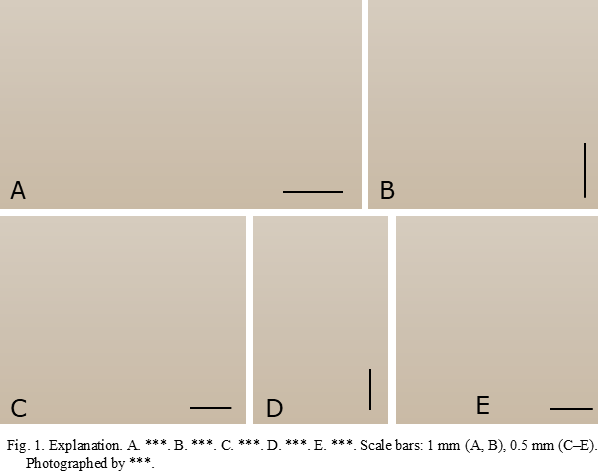
- ・A composite figure is a figure consisting of multiple graphical elements (hereafter referred to as panels)
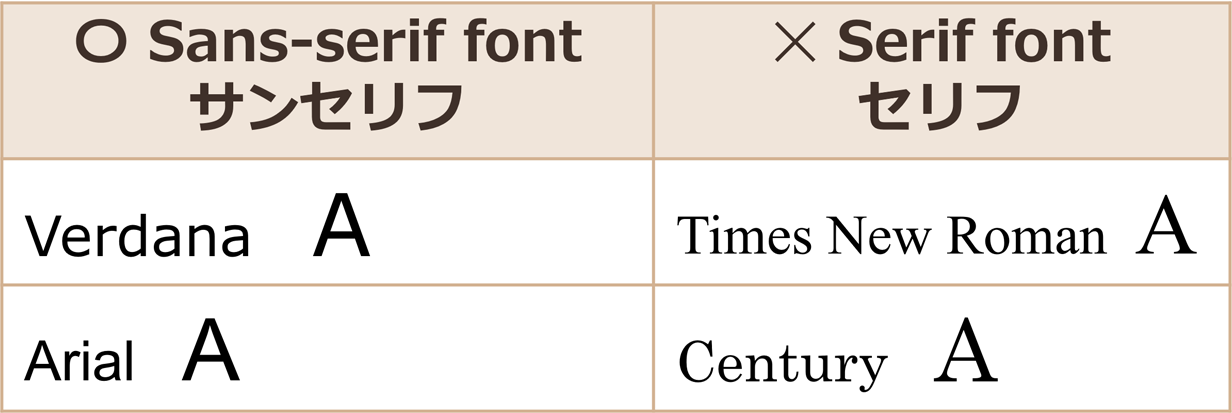
- ・Use uppercase letters to identify each panel, placed in the lower left corner using a sans-serif font (see "Font examples").
Font examples:
- ・When creating composite figures, refer to the "Composite figure example" below and the latest articles in this journal.
Composite figure example:
17.6.Digital Image Manipulation
- ・"Simple" digital manipulation, such as adjustment of brightness, contrast or conversion of color images to grayscale, is permitted as needed.
- ・Other digital manipulations should be performed with the following points in mind.
- 1Digital manipulation should be performed on a copy of the image, and the original image should be kept unprocessed.
- 2The aspect ratio of the image must not be changed.
- 3If digital manipulation beyond simple correction is performed, it is recommended to clearly state the operation in the figure caption.
- 4When discussing the color, shape, or size of the subject, it is recommended to photograph with a color chart or scale whenever possible.
17.7.Use of AI-Generated Figures
When utilizing figures generated by AI, it is necessary to provide explicit information in the figure legend regarding the AI model or algorithm used. Additionally, author(s) should explain an overview of the instructions or commands given to the AI in the main text.
18.Tables
18.1.Table Preparation
- ・Table file format must comply with '2. File Format for Submission Data'.
- ・Table captions (title or explanation of table) and foot notes should be included in the table itself.
18.2.Citation of Tables in the Main Text
- ・Authors should ensure that every table is cited in the main body text.
- ・Table numbers should be assigned based on the order in which they are cited in the body text.
18.3.Table Captions
Figure captions should be in English. For manuscripts written in Japanese, Japanese captions may be added after the English captions.
18.4.Table Submission
- ・Tables must be prepared as one file per table and submitted separately from the main manuscript.
- ・Tables must not be submitted as images.
19.Appendices
- ・In general, an appendix should be included at the end of the body text as plain text.
- ・If authors choose to submit an appendix in figure format, '17. Figures' applies.
- ・If authors choose to submit an appendix in tabular format, '18. Tables' applies.
20.Supplementary Data
- ・Data and materials essential for the validity of the paper must be included in the main text. Other supporting data and materials that form the basis of the paper may be published either in public repositories or databases, or as electronic Supplementary Data on J-STAGE.
- ・The final decision regarding whether the materials will be published as electronic Supplementary Data will be made by the Editorial Board.
- ・Any data or materials intended to be registered as Supplementary Data must be submitted at the time of manuscript submission. In principle, submissions after acceptance will not be permitted.
- ・Note that the supplementary data that can be published as electronic supplements is limited to fewer than 100 files per submission, with each file not exceeding 50 MB in size. Please refer to the following document for the required file formats for supplementary data: https://www.jstage.jst.go.jp/static/files/ja/UM-01-004_sousa(henshu)_append5.pdf.
21.Revision History
| Date | Summary of Revisions |
|---|---|
| 6 May 2023 | Established. |
| 5 Sep. 2023 | Added examples of web page citations. |
| 11 Sep. 2023 | Added regulations regarding address for correspondence of submission, figures, and appendices. |
| 20 Feb. 2025 |
|
| 20 May 2025 |
|
| 19 June 2025 |
|
| 10 Oct. 2025 |
|
| 10 Nov. 2025 |
|
| 25 Mar. 2026 |
In Article 12 References, the citation language of the references is revised to Latin script from Roman script. |
| 9 Apr. 2026 |
Minor editorial revisions, including formatting, wording, and typographical corrections, were made throughout the document. |
| 31 July 2026 |
|
